Chapter 12: Fly Fishing for Florida Saltwater Species
Understanding the Fish, the Forage, and the Fly
Florida is one of the most diverse saltwater fly-fishing destinations in the country.
From shallow grass flats and mangrove shorelines to passes, beaches, bridges, and nearshore waters, Florida offers fly anglers the opportunity to target an incredible variety of saltwater species.
But catching those fish consistently requires more than knowing how to cast.
Every species has its own habits, preferred habitat, feeding behavior, and preferred prey. Understanding those differences allows you to make better decisions about where to look, which fly to use, and how to present it.
In Chapter 11, we learned how to select a fly based on forage, size, profile, water clarity, and conditions.
Now it’s time to put those principles into practice.
12.1 — Start With the Predator
Before choosing a fly, start with the fish.
Ask yourself:
What species am I targeting?
Then ask:
Where does that species want to be?
And finally:
What is it likely to be eating?
A redfish cruising across a shallow flat is looking for food differently than a tarpon traveling along a beach. A snook holding tight to a mangrove shoreline has different opportunities than a jack crevalle chasing bait in open water.
Understanding the predator gives you a starting point.
From there, you can use what you learned in Chapter 11 to select the appropriate fly.
12.2 — Snook
Snook are one of Florida’s most popular saltwater game fish, and for good reason.
They are powerful predators that can be targeted in a wide variety of environments, including mangrove shorelines, passes, docks, beaches, bridges, and shallow flats.
Snook frequently feed on baitfish, but their diet can also include shrimp, crabs, and other prey.
Fly Selection
Baitfish patterns are an important part of a snook fly box.
Look for flies with:
- A realistic baitfish profile
- Natural colors
- Appropriate size
- Good movement
- Durable construction
The correct size depends heavily on the available forage.
If small baitfish are present, a smaller pattern may be appropriate. If larger bait is concentrated around the shoreline, a larger profile can make sense.
Presentation
Snook often respond to a fly that appears to be an easy meal.
Depending on the situation, this can mean stripping the fly with short, controlled movements or using a faster retrieve when fish are actively chasing bait.
The most important factor is getting the fly into the area where the fish are holding.
12.3 — Redfish
Redfish are one of the classic sight-fishing targets in Florida.
Shallow flats provide some of the most exciting opportunities because anglers can often see the fish before making the cast.
Redfish may feed on:
- Shrimp
- Crabs
- Small baitfish
- Other bottom-dwelling prey
Fly Selection
Redfish are an excellent example of why anglers should carry multiple fly categories.
A shallow flat covered in shrimp calls for a very different approach than a school of redfish actively chasing bait.
Shrimp and crab patterns are particularly useful when fish are feeding close to the bottom.
Presentation
Stealth is extremely important.
Long casts, quiet presentations, and controlled retrieves can make a significant difference.
When sight fishing, don’t simply cast at the fish.
Try to determine where the fish is moving and place the fly where it can naturally encounter it.
Think about the fish’s direction of travel.
Lead the fish rather than throwing directly at it.
12.4 — Spotted Seatrout
Spotted seatrout are another important Florida saltwater species and can provide excellent opportunities for fly anglers.
They can be found around grass flats, potholes, deeper edges, and other areas where bait and forage concentrate.
Trout may feed on smaller baitfish, shrimp, and other prey.
Fly Selection
Smaller baitfish patterns and shrimp-style flies are useful starting points.
If trout are actively feeding on bait, focus on matching the size and general profile of that bait.
If they are feeding closer to the bottom, a shrimp or other subsurface pattern may be more appropriate.
Presentation
Trout do not always require an extremely fast retrieve.
Experiment with the speed and cadence of your strips while paying attention to how the fish respond.
If fish are following without committing, try changing the retrieve before immediately changing flies.
12.5 — Tarpon
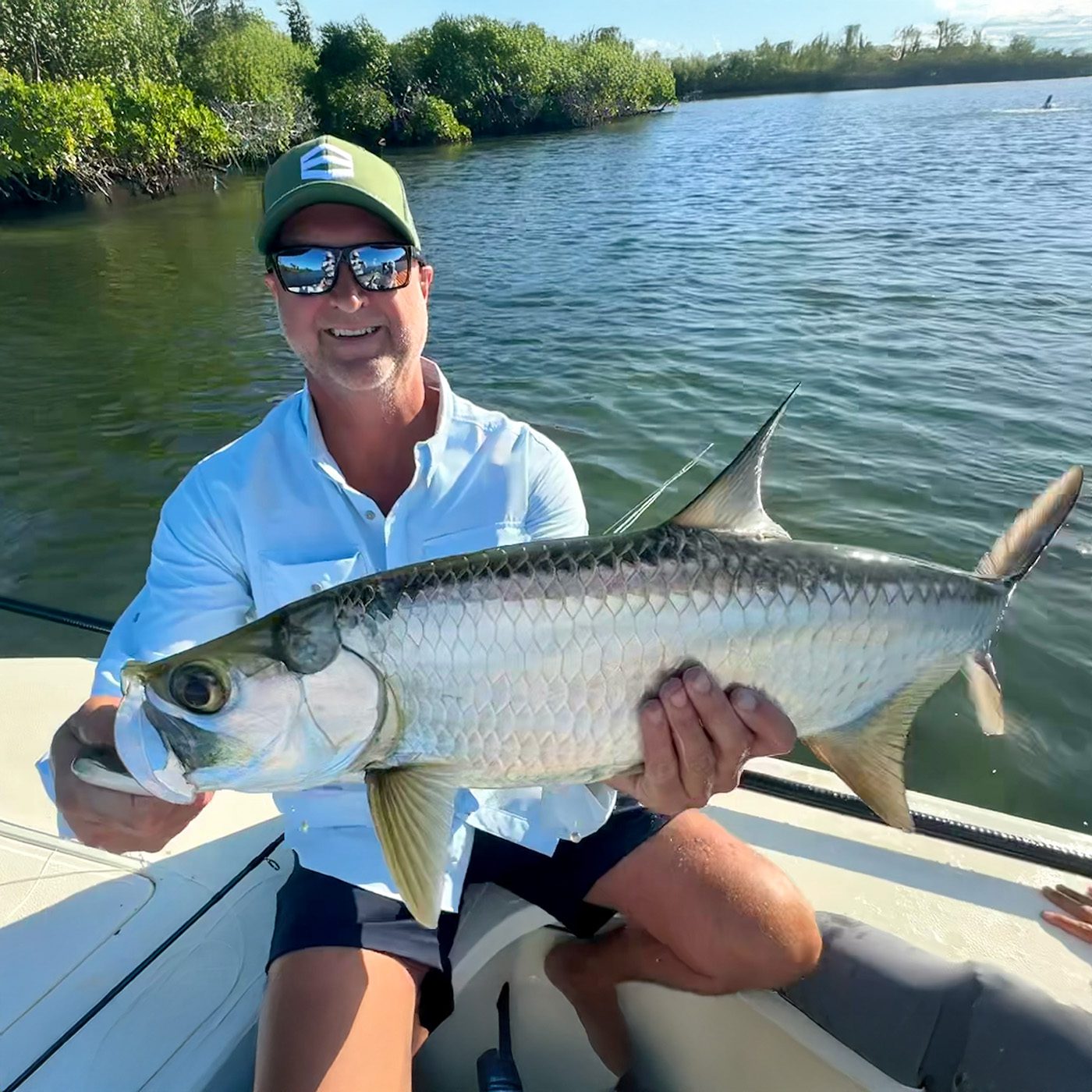
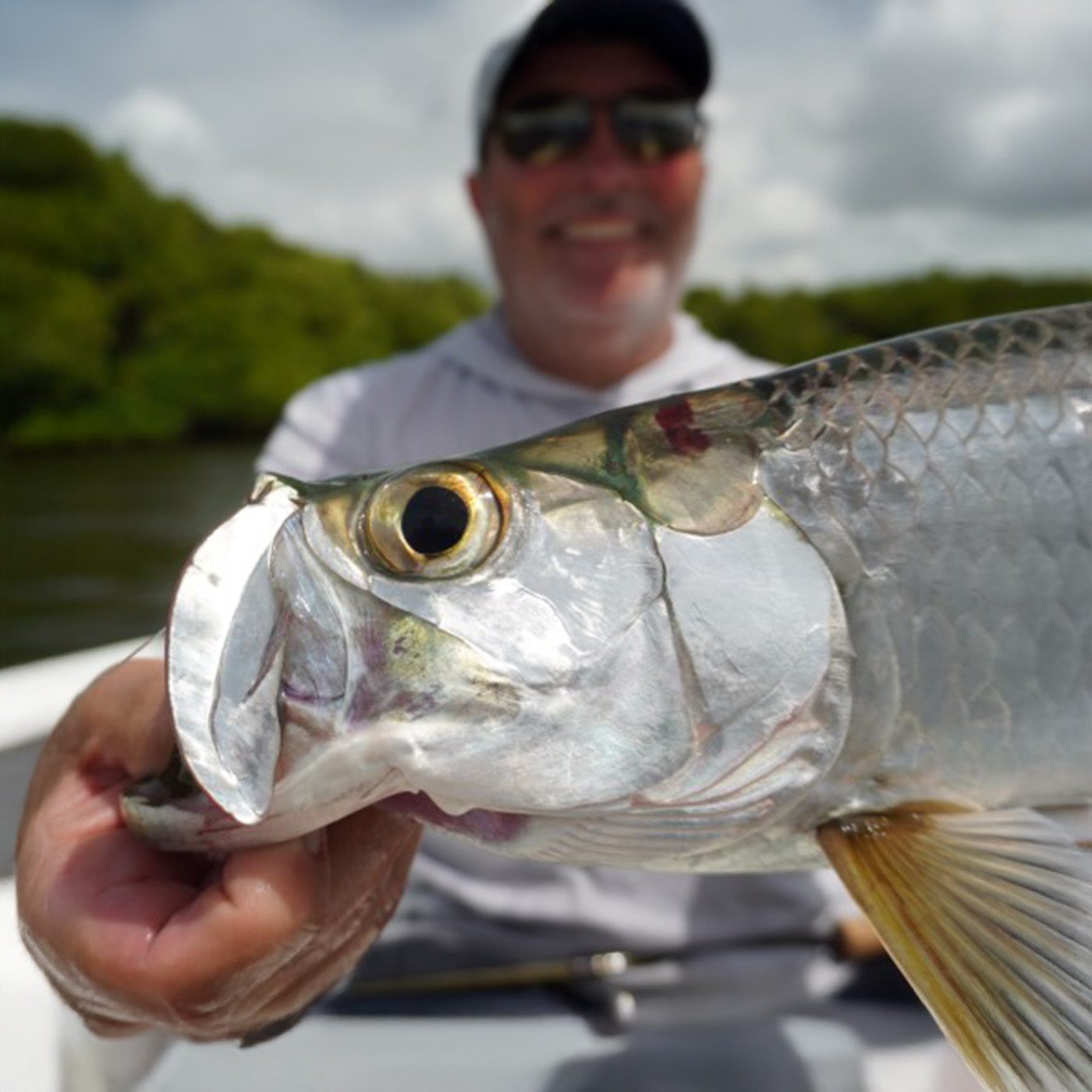
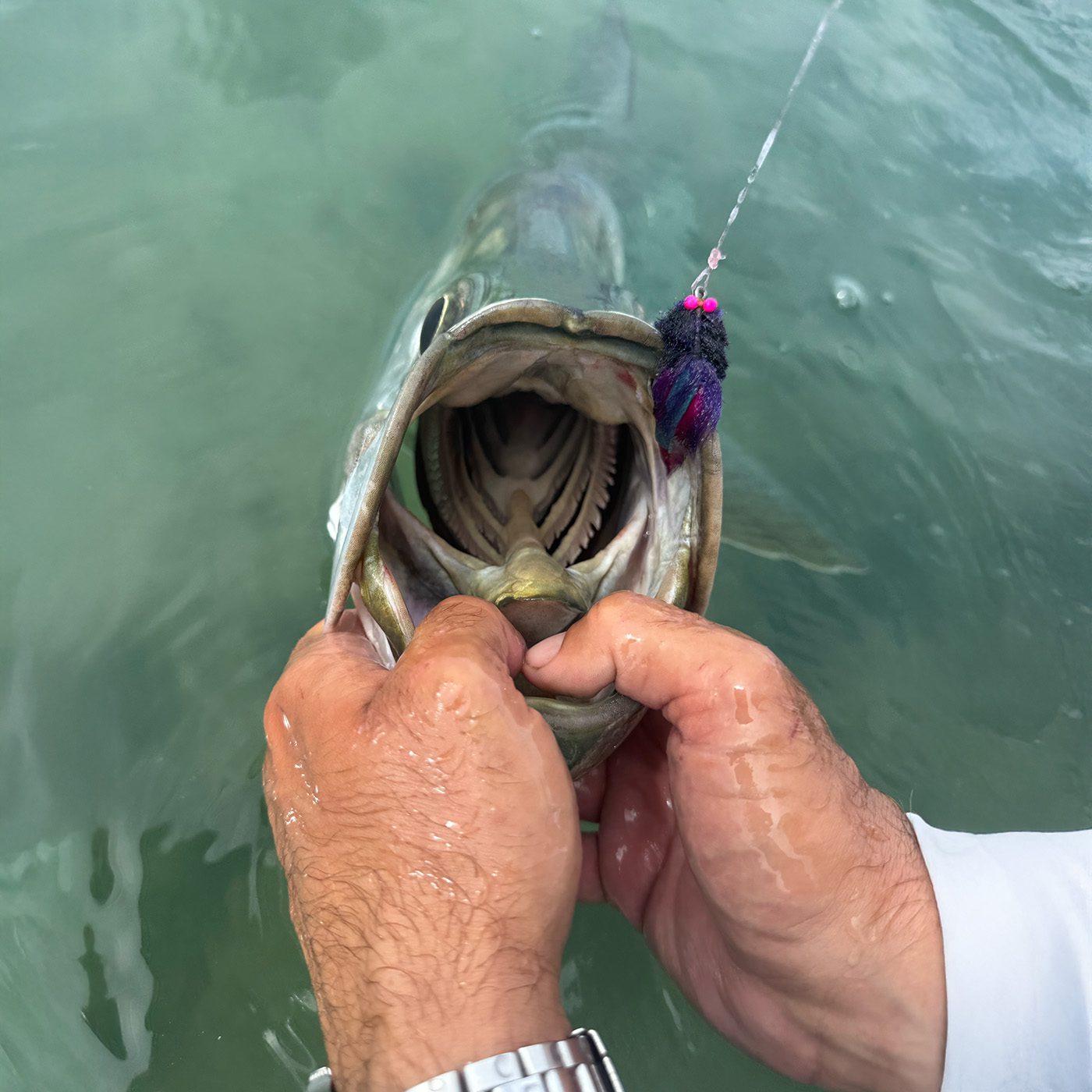
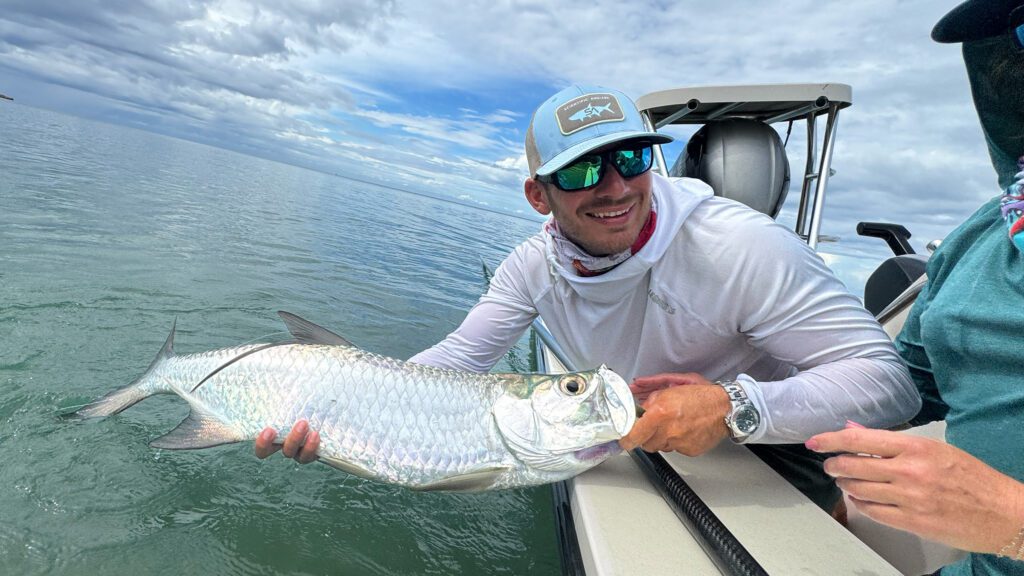
Few saltwater fly-fishing experiences compare to seeing a tarpon eat a fly.
Tarpon are powerful, highly specialized predators, and they can be extremely challenging on fly.
They may feed on baitfish, crabs, shrimp, and other prey depending on their environment and the conditions.
Fly Selection
Tarpon flies can vary dramatically in size and profile.
The most important consideration is understanding what the fish are feeding on.
If tarpon are eating small bait, a giant fly may be counterproductive.
If larger forage is present, a larger profile may be appropriate.
Color, silhouette, movement, and presentation all matter.
Presentation
Tarpon often require patience.
A successful cast is only part of the equation. The fly needs to be placed correctly, presented naturally, and retrieved in a way that gives the fish an opportunity to eat.
The angler must also be prepared for what happens after the bite.
Once a tarpon eats, the fight is only beginning.
12.6 — Jack Crevalle
Jack crevalle are some of the most aggressive predators an angler can encounter in Florida saltwater.
When they are actively feeding, the visual experience can be spectacular.
Schools of jacks may push bait to the surface, creating obvious signs of feeding activity.
Fly Selection
When targeting jacks, larger baitfish patterns are often appropriate.
The fly should be durable enough to withstand aggressive strikes and repeated attacks.
Presentation
Speed can be extremely important.
When jacks are chasing bait, a fast retrieve can trigger an aggressive response.
However, don’t automatically assume that faster is always better.
The fish’s behavior should determine the retrieve.
If they are actively chasing bait, match that energy.
12.7 — Tripletail
Tripletail are an excellent sight-fishing species.
They can often be found around floating structure, debris, buoys, and other objects where they use cover and ambush prey.
Their unusual appearance and behavior make them one of Florida’s most interesting saltwater targets.
Fly Selection
Tripletail may respond to smaller baitfish and crustacean-style patterns.
Because these fish can be highly visible, accurate presentation is critical.
Presentation
One of the biggest advantages of targeting tripletail is the ability to see the fish and make a deliberate cast.
Don’t rush.
Take the time to determine the fish’s position and place the fly where it can see the presentation naturally.
12.8 — Spanish Mackerel
Spanish mackerel are fast, aggressive predators that commonly feed on smaller baitfish.
They can provide exciting opportunities for fly anglers because their feeding behavior may be highly visible.
Fly Selection
Slim baitfish patterns are a logical choice.
Think about:
- Small baitfish
- Flash
- Slim profiles
- Appropriate size
Presentation
Mackerel are fast.
When fish are actively feeding, a fast retrieve can be effective.
A long cast followed by a quick, consistent retrieve can imitate a fleeing baitfish.
Because mackerel have sharp teeth, anglers should also pay attention to leader selection and fly durability.
12.9 — False Albacore and Other Nearshore Speedsters
Fast-moving predators require a different approach from fish cruising shallow flats.
False albacore and similar nearshore predators can move quickly and cover significant distances while feeding.
The challenge isn’t simply choosing the correct fly.
It’s getting the fly in front of a moving target.
Fly Selection
Small baitfish patterns can be extremely useful when these predators are feeding on small forage.
A streamlined profile helps the fly cast efficiently while allowing it to move naturally through the water.
Presentation
Long casts are often valuable.
Once the fly is in the water, the retrieve may need to be fast enough to imitate fleeing bait.
The key is anticipation.
Don’t wait until the fish are directly in front of you before starting the cast.
12.10 — Permit
Permit have developed a reputation among fly anglers for being one of the most challenging saltwater targets.
They are often associated with shallow flats and can be targeted with crab and shrimp patterns.
Fly Selection
Crab patterns are an important part of the permit fly box.
Size, weight, color, and presentation all matter.
A fly that reaches the appropriate depth and behaves naturally can be more important than having the most elaborate pattern.
Presentation
Permit fishing requires patience.
The fish may inspect the fly before committing—or ignore it completely.
A controlled, subtle presentation is often more appropriate than aggressively stripping the fly.
12.11 — Match the Strategy to the Species
One of the biggest mistakes beginning saltwater fly anglers make is fishing every species the same way.
They aren’t the same fish.
A useful starting framework is:
| Species | Common Forage | Fly Focus | Presentation |
|---|---|---|---|
| Snook | Baitfish, shrimp | Baitfish patterns | Moderate to fast |
| Redfish | Shrimp, crabs, baitfish | Shrimp, crab, baitfish | Slow to moderate |
| Seatrout | Baitfish, shrimp | Smaller baitfish/shrimp | Slow to moderate |
| Tarpon | Baitfish, shrimp, crabs | Species-appropriate profile | Varies |
| Jack Crevalle | Baitfish | Larger baitfish | Often fast |
| Tripletail | Small baitfish, crustaceans | Compact bait/crustacean | Slow/subtle |
| Spanish Mackerel | Baitfish | Slim baitfish | Fast |
| Permit | Crabs, shrimp | Crab/shrimp | Slow/subtle |
This isn’t a rigid rulebook.
It is a starting point.
The fish and conditions should always have the final say.
12.12 — Building a Florida Species Fly Box
Instead of buying dozens of random patterns, build a fly box around categories.
Start with:
Small Baitfish
Useful for trout, mackerel, smaller predators, and situations involving tiny forage.
Medium Baitfish
A versatile category for snook, trout, jacks, and other predators.
Large Baitfish
Useful when targeting larger predators or when large bait is present.
Shrimp
Important for redfish, trout, permit, and other species.
Crab
An important category for redfish and permit situations.
Dark Profiles
Useful when contrast and silhouette are important.
Bright or High-Contrast Flies
Useful in certain visibility and water conditions.
The idea isn’t to own every fly.
It’s to have enough variety to adjust size, profile, color, and presentation.
12.13 — Seasonal Changes
Florida saltwater fishing changes throughout the year.
Water temperatures change.
Bait populations change.
Fish locations change.
Weather patterns change.
Because of this, the fly that worked yesterday may not be the fly you want tomorrow.
Instead of thinking about fishing as a fixed formula, think about it as a constantly changing system.
Observe the water every time you go.
Look for:
- Bait concentrations
- Bird activity
- Surface feeding
- Water temperature changes
- Tidal movement
- Current
- Water clarity
- Seasonal forage
The fish are responding to those conditions, and your fly selection should respond as well.
12.14 — Putting It All Together
Imagine arriving at the water for a morning of sight fishing.
Before opening your fly box, you observe the area.
You see shallow water, clear conditions, and several redfish moving across the flat.
You notice small baitfish in one area and shrimp activity closer to the bottom.
Now you have information.
Instead of choosing a fly randomly, you can make a decision.
You might begin with a small baitfish pattern if the fish are actively chasing bait.
If the fish are slowly cruising and appear to be feeding near the bottom, a shrimp or crab pattern may make more sense.
If the fish follow but don’t eat, you can adjust the retrieve.
If that doesn’t work, change size.
Then profile.
Then color.
The important thing is that every adjustment has a purpose.
This is what separates random fly changes from deliberate fly fishing.
12.15 — Common Mistakes
Fishing the fly instead of fishing the fish
Don’t become so focused on the fly that you forget to watch the fish.
Casting directly at the fish
Lead moving fish whenever possible.
Ignoring forage
The water is constantly giving you clues.
Pay attention.
Using the same fly for everything
Different species and conditions require different approaches.
Changing everything at once
Change one variable at a time whenever possible.
Focusing too much on color
Size, profile, movement, and presentation can be equally—or more—important.
12.16 — The Species Decision Process
When targeting a Florida saltwater species, work through this checklist:
- What species am I targeting?
- Where should that species be holding?
- What forage is available?
- What size is that forage?
- Is the fish actively feeding?
- What depth are they using?
- What is the water clarity?
- What fly best represents the available forage?
- How should I present it?
- What adjustment should I make if the fish doesn’t eat?
This process gives you a repeatable system rather than relying on luck.
Chapter 12 — Final Takeaway
Florida saltwater fly fishing becomes much easier when you stop thinking about flies as individual patterns and start thinking about them as tools.
A baitfish pattern is a tool.
A shrimp pattern is a tool.
A crab pattern is a tool.
A large-profile fly is a tool.
A small-profile fly is a tool.
Your job as an angler is to determine which tool fits the situation.
Learn the fish.
Learn the forage.
Read the water.
Choose the fly.
Then make the presentation.
The more you practice this process, the less intimidating fly selection becomes.
You don’t need to memorize every fly in the fly shop.
You need to understand what the fish are trying to eat and how to give them a convincing opportunity to eat it.
That’s the foundation of successful Florida saltwater fly fishing.
About Tampa Bay Guide Service
Ready to put these techniques into practice?
Tampa Bay Guide Service offers guided saltwater fishing experiences throughout the Tampa Bay region, giving anglers the opportunity to learn how to identify fish, read conditions, select flies, and improve their presentation on the water.
Book a guided trip and take the next step in your Florida saltwater fly-fishing journey.